

Transform the Way You Manage Early-Stage Melanomas

Studies show that the majority (80-85%) of melanoma patients who undergo the sentinel lymph node biopsy (SLNB) surgery are negative for nodal metastasis.
Additionally, while some patients remain free of metastasis in the long term despite having positive nodal status, others may develop recurrence within five years even when no nodal involvement is detected at surgery.
This means that it becomes crucial to identify two groups of patients:


The Merlin test refines nodal metastasis and survival risk estimates for improved personalized care

The Merlin Test Enhances Risk Stratification Beyond Traditional Staging
Every melanoma is unique. Patients with the same clinical stage may still have very different tumor biology, resulting in wide variation in their risk of metastasis and recurrence. Traditional staging alone may fail to capture these biological differences, leading to misclassification of metastatic risk at diagnosis and, consequently, to potential overtreatment or undertreatment.
The Merlin Test delivers personalized, molecular-based predictive and prognostic insights that complement traditional staging and improve the accuracy of melanoma risk assessment -helping guide more precise care for each patient.
The Merlin Test Provides Deeper Insights Into Melanoma Aggressiveness
Current treatment decisions often rely on clinicopathologic factors such as patient age, Breslow thickness, and ulceration. While important, these variables alone do not always capture the full picture of a patient’s melanoma or their individual risk. The Merlin Test offers a more comprehensive understanding of your patient’s cancer – without requiring any additional procedures.
Using the CP-GEP model, an algorithm developed through logistic regression, the Merlin Test integrates clinicopathologic features (age and Breslow thickness) with gene expression data from 8 key genes associated with melanoma metastasis. This combined approach provides personalized predictive insights, helping you better assess risk and optimize treatment planning.


The Merlin Test Supports Your Decision-Making
The Merlin Test enhances clinical management by providing reliable risk stratification for each patient. Validated in multiple multicenter studies across the United States and Europe, the test consistently distinguishes two clinically meaningful patient groups, delivering a straightforward binary result that informs treatment decisions.

MERLIN_001 is the largest blinded prospective trail of genomic assay conducted in melanoma (2,141 patients screened).

The Merlin Test is specifically designed to provide sentinel lymph node biopsy (SLNB) outcome prediction, along with long-term prognostic information.
Validated through the prospective, multicenter MERLIN_001 clinical trial in collaboration with leading academic institutions, the Merlin Test delivers robust evidence to support its role in melanoma risk assessment and patient management.
Collaborating Academic Institutions
- Duke University
- Emory University
- H. Lee. Moffitt Cancer Center
- Huntsman Cancer Center
- Mayo Clinic
- Memorial Sloan Kettering Cancer Center
- University of Kentucky
- University of Louisville
- University of Michigan

Interpreting the Test Result
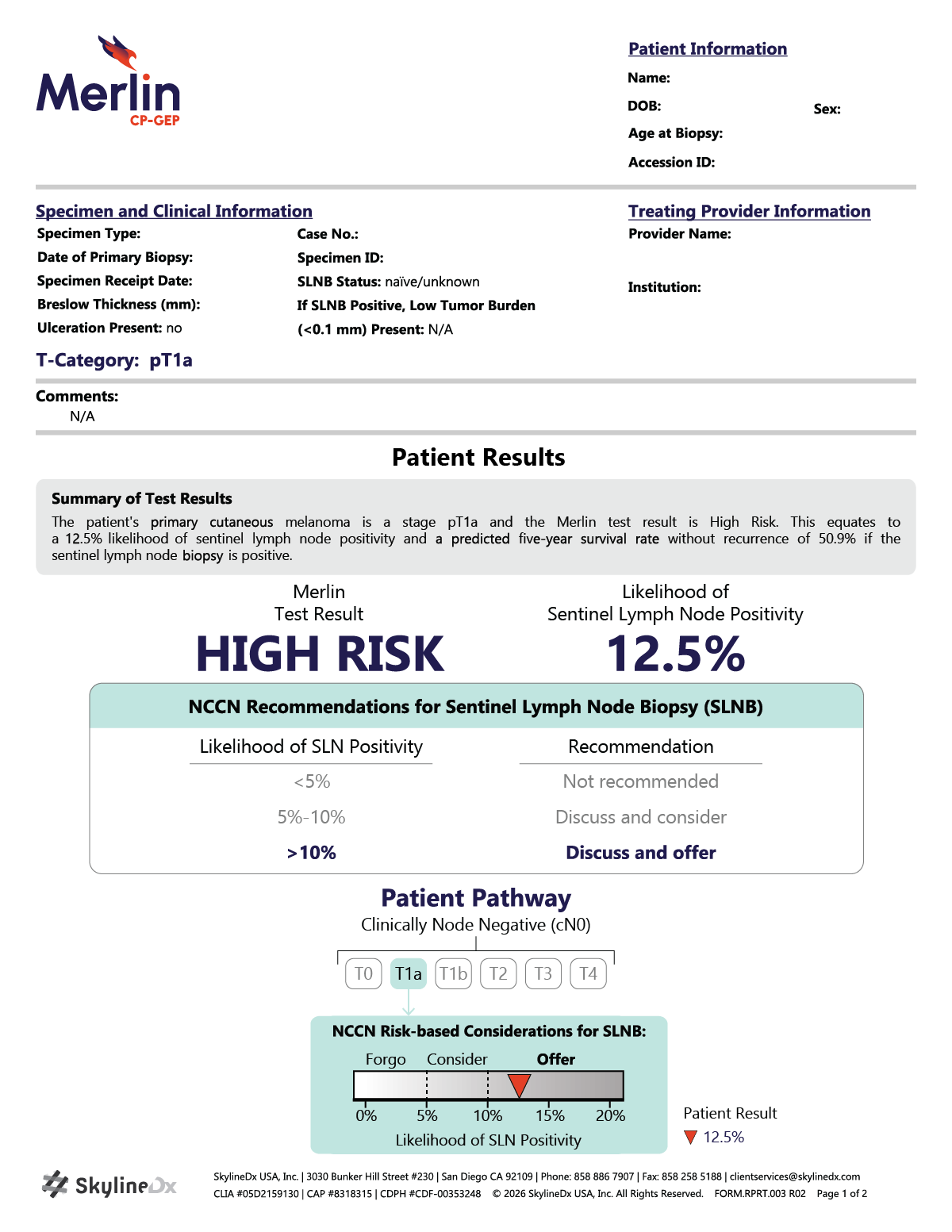
Merlin Test Result
The risk label is determined by analyzing the expression of 8 genes from the patient’s tumor sample, combined with patient age and tumor thickness.
Prediction
Provides a personalized estimate of metastatic risk, supporting clinical decisions such as whether to perform SLNB.
Prognosis
Delivers individualized risk estimates for melanoma recurrence and survival over 5–10 years, helping guide long-term management and follow-up care.